Android is going to be huge
Android is going to be larger than the iPhone, by far, for exactly
the same reasons Microsoft Windows beat Apple the last time
a new platform emerged.
I can’t stress how significant Android will be to the future of
computing. Some very well connected and experienced
people have suggested the mobile computing platform (smart
phones if you will) will be larger than the PC industry. I believe it.
So I bet in a few years time Android will be larger than iPhone and in 10 years it will
have 80% market share and be part of an industry larger than the PC industry.
If I was a software developer today I’d be focussing entirely on the mobile platform
(and that includes the mobile web-based platform). Oh, I am a software developer...
The iPhone is a better product, in almost every way, than an Android phone right now.
Let’s be honest here Android is simply a copy of the pioneering work Apple did (they
always get copied, just like Windows was a poor copy of the Mac). For the last 2 years
phone development by all the leading phone developers from Nokia, Sony, Palm to
Microsoft and Google, has been just copying, or playing catch-up with Apple. Of course
they are all trying to improve the benchmark set by Apple, and I'm sure in some ways
they will improve upon it (not much point in playing the game if you can’t improve
things).
So why will Android be so significant? Because it’s good product (probably better than
any other mobile platform, iPhone (and perhaps the Palm Pre) excepted), and it’s free
to phone manufacturers, just like MS DOS was (as good as) free to early PC
manufacturers. Apple keep things to themselves. It has been argued it was the wrong
decision for Apple in 1984 not to license the Mac OS, and it lost them the world. It will
do the same again.
But all credit to Apple, they really are the world's greatest gadget and software
innovators around, and one of the greatest hardware designers as well.
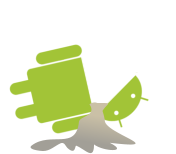
Bad Robot
Android is actually crap. It's a broken robot.
‘Hang on, you just said it is going to be BIG, in capitals no less’ I hear you say.
Ah yes, but big doesn’t mean good. Just look at Windows. Back when it counted the
Mac was better, and Windows merely adequate. But ‘adequate’ was all that was needed
when it was a cheap as peanuts and everyone wanted to get on the PC bandwagon.
Apple was not interested in licensing the Mac OS. So Microsoft cleaned up. Eventually
Windows got a lot better and after a while it was actually better than the Mac (back
when Steve Jobs was no longer there and Apple was run by a bunch of corporate types
who had no clue, not just about technology, and couldn’t build anything decent). Over
this period of relatively few critical years, Microsoft gained the world.
So why is Android bad? There are some major technical drawbacks to Android, such as
its use of Java as the main language for application development. This limits the
performance of native Android apps, and inevitably results in software bloat. Google
and others are beginning to provide work-arounds to allow easier C, C++ or even native
ARM code.
Having spent my entire career specialising in high-performance, super-optimized code,
the thought of using Java, and worse, an interpreted Java, in a low-powered hand-held
device is, well, just short of unbelievable.
For the techies, more details here
Does it matter that Android is a slow robot? Probably not for the main things you use a
phone for. But you certainly ain’t going to be writing any fast, optimized games in
Interpreted Java. And that’s something the iPhone excels at.
So despite the fact Android is flawed, it's still going to be BIG, in capital letters still.

September 2009

1st September 2009



A web log, a test of my web design software, stories about the absurd, the dumb & interesting stuff.